
Overview
GitHub and Microsoft’s GitHub Copilot are now available to NASA-funded projects as paid services managed by the Science Cloud. The Science Cloud handles the operational and security infrastructure, including identity and access management, operational controls, and subscription management. (Note: This service runs on GitHub.com exclusively and is entirely separate from developer.nasa.gov, the on-premises NASA-hosted GitHub).
To see core capabilities, live demonstrations, and best practices for integrating Copilot into your daily workflow, we recommend reviewing our official March 2026 Launch Presentation.
Success Stories: How NASA Teams Are Using Copilot
In the March 2026 showcase event, several projects shared how they are using GitHub Copilot to accelerate and improve their research pipelines.
- NASA POWER (Streamlining Security and APIs): The Prediction Of Worldwide Energy Resources project—serving NASA Earth observation data to over 1.8 million users—used AI agents to identify and remove dead code. This clean-up slashed loading times for their Data Access Viewer and saved weeks of developer time. Furthermore, they reduced their Docker image size by 50%, improving hourly data response times by 62%. This translated to a 33% reduction in cloud operating costs while serving 5% more daily requests and delivering 7% more data.
- Model Training & Manuscript Preparation (Langley Research Center): James Warner, PhD, used Copilot to profile and optimize a model training workflow, reducing execution time on four GPUs from 33 hours to just 10 hours (a 3.3x speed-up). He also used AI to standardize complex publication-ready visualizations in Python, reducing a tedious 2+ hour task to just 30 minutes (a 4x speed-up). Takeaway tip from James: Reset your expectations often as models improve rapidly, always use verification checks, and learn alongside your colleagues.
- Infrastructure Modernization (GMAO): Alexey Shiklomanov, PhD, demonstrated Copilot’s OpenCode agentic coding tool in the terminal. In under 10 minutes, he used Copilot to analyze an existing project structure, create a publicly accessible S3 bucket, upload a test image, produce a public URL, and then destroy the infrastructure—a process that would have taken hours manually.
- Accelerating the Science Cloud Itself: The internal Science Cloud team used AI-assisted workflows to deliver 11 new features and ~33,000 lines of production code, tests, and documentation in just 40–75 engineer-days. Traditionally, this would have required 165–245 days. Copilot reduced cost and calendar time by 65–75% while producing higher documentation and test coverage than typical for projects of that scale.
Copilot Options and Capabilities
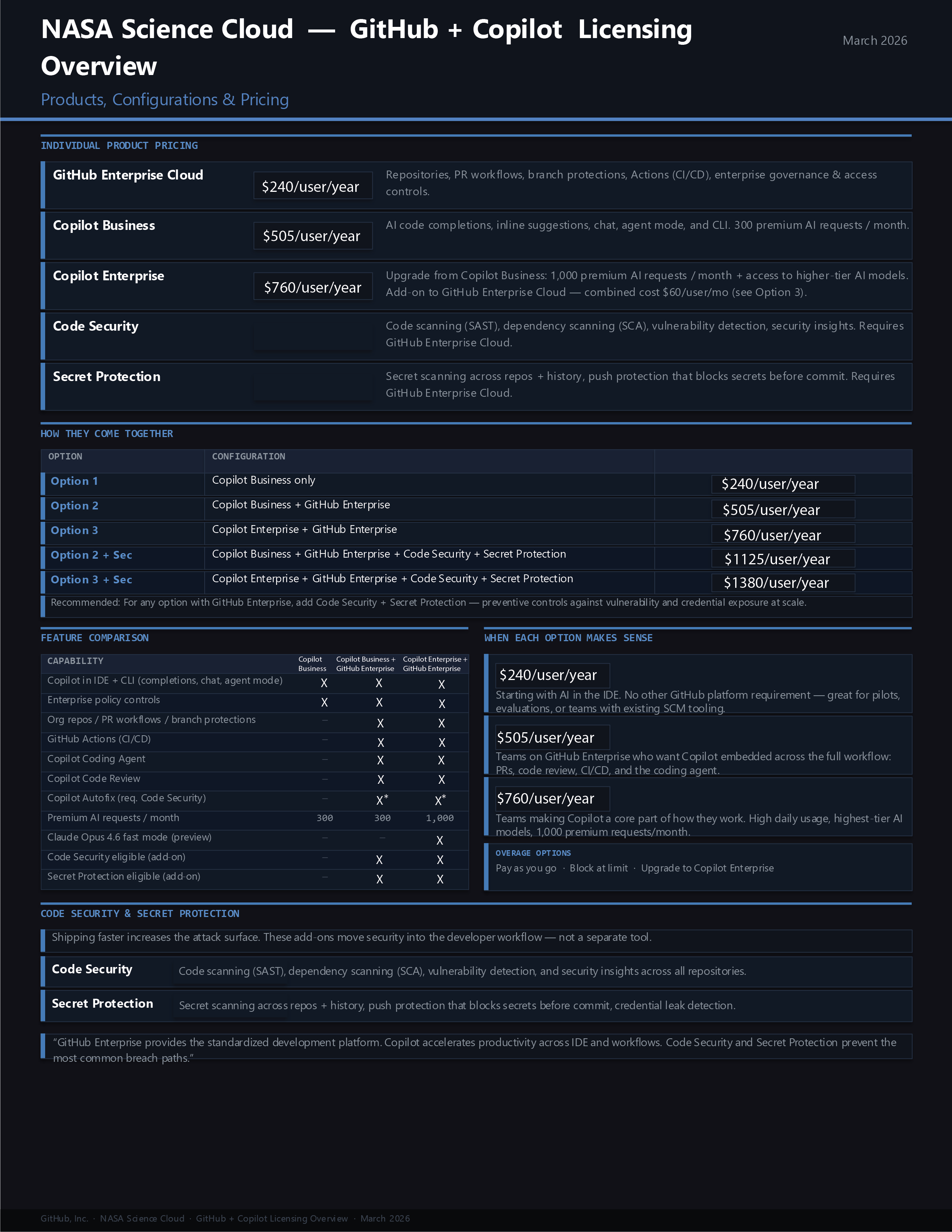
We offer several subscription tiers to meet the specific needs of your project. Please note that prices are subject to a ~5% overhead fee to cover CCS and Science Cloud operations. A minimum 1-year subscription is required. Please contact us for updated pricing.
Getting Started & Operations
To streamline processing, onboarding must be PI-led. We strongly encourage project members to coordinate with their Principal Investigator (PI) to submit bulk onboarding requests as a group, ensuring funding is confirmed prior to provisioning.
- Provisioning Timeline: Once funding is officially confirmed, the Science Cloud team typically completes access provisioning within 1 to 2 business days.
- Invitations: You will receive your organization invitation directly from GitHub. Look for Aaron Skolnik's referee icon on the invitation! Please accept promptly, as invitations expire after 7 days.
- Authentication: Single Sign-On (SSO) via the Science Cloud's Azure Entra ID is being rolled out enterprise-wide. Upon your first login to access enterprise features, you will be prompted to authenticate securely through SSO.
Transferring and Managing Funds
Because GitHub Copilot is a managed cloud service, all funding must be properly obligated before resources are used.
- Fund Transfers: Funds must be transferred to Ames Research Center (ARC), where CCS manages the Science Cloud contracts on Azure. Moving funds between centers typically requires your Resource Analyst (RA); we will provide an ARC point of contact to help facilitate this transfer.
- Account Balances: Subscriptions operate on a monthly billing cycle and cannot be paused for partial periods. Organizations are not permitted to go into arrears; if funds are exhausted, the subscription will be suspended.
- Notifications: To prevent service interruption, automated alerts will be issued to your team when funds drop below three months of coverage.
- Overages: Exceeding the monthly premium quota (e.g., 300 requests on lower tiers) does not halt your subscription but will incur additional costs that effectively reduce your remaining funded period. (Tip: The break-even point for upgrading from Copilot Business to Copilot Enterprise is 800 premium requests per month).
- Early Termination: If a project ends early, our team will work with your PI and RA to de-obligate unused funds where possible.
Security & Compliance Considerations
GitHub Copilot operates strictly as a FISMA Low system. Because Copilot learns from user inputs, it is critical that users keep their prompts and code clean.
- PROHIBITED DATA: You must not process or commit Personally Identifiable Information (PII), ITAR, EAR, or Controlled Unclassified Information (CUI) to this system.
- PERMITTED DATA: Content is strictly limited to unclassified, publicly releasable information, source code/documentation not subject to export controls, and non-CUI research and development work.
When in doubt about whether your data is safe to commit, please stop and contact Science Cloud ISSO Tara Leonard or another Science Cloud team member.
How to Sign Up
Ready to bring GitHub Copilot to your team?
- Submit a Ticket (Preferred): Register and log in to the Jira Service Portal at https://jira.sciencecloud.nasa.gov/servicedesk/customer/portal/34 to submit your request and easily monitor its progress.
- Email: You can also send a request to support@sciencecloud.nasa.gov.