
This guide features one section per tool. Each section explains what the tool is, where to find it, provides an example, and highlights what to watch out for. Prefer a step-by-step walkthrough? Read the Quick Start Guide instead.
Tools at a Glance
| Tool | Common Question | Availability |
|---|---|---|
| JupyterLab and Notebooks | Where do I work? | Everyone |
| Machine Sizes and Images | How much compute power do I get? | Everyone |
| Storage | Where do my files go, and what survives a restart? | Everyone |
| Your Own Kernel | How do I install my own packages? | Everyone |
| Notebook Intelligence | Can |
| SI help me code? | Everyone | |
| Data Browser | How do I access cloud data? | Everyone |
| Dask | How do I speed up processing? | Everyone |
| NBQueue | How do I execute long-running tasks? | Everyone |
| RTC Launcher | How do we edit together? | Projects with collaboration enabled |
| Resource Tracker | What am I spending? | Everyone |
| SI Registry | What shared |
| SI components can I reuse? | Rolling out | |
| Git | How do I manage code versions? | Everyone |
1. JupyterLab and Notebooks
...
Example: Open the Launcher, click on a Python notebook, type print("hello"), and press Shift+Enter.
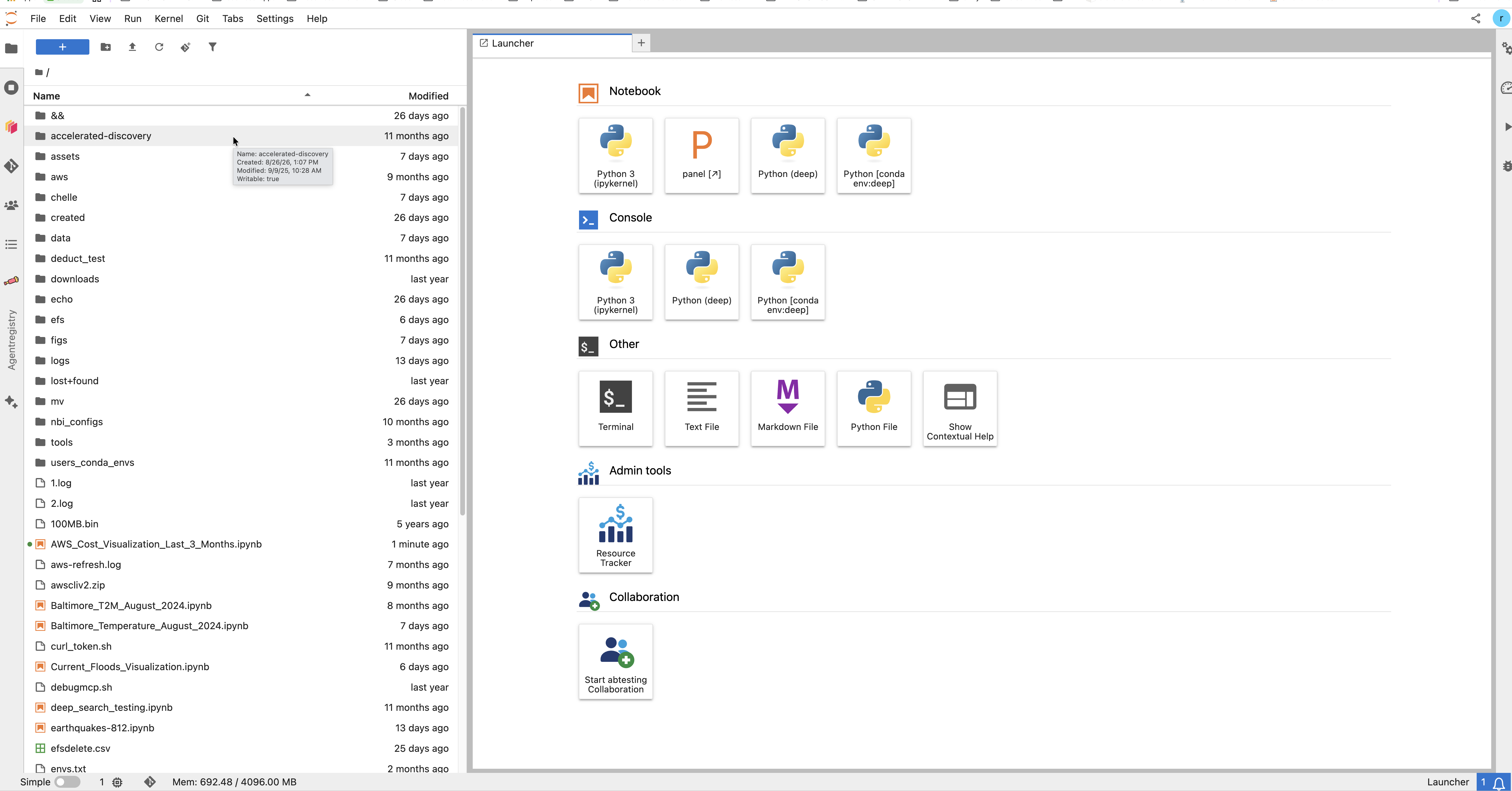
JupyterLab: file browser, Launcher tiles, and the platform tools down the left edge.
...
Your server type dictates your compute power. Because larger machines cost more per hour, you should select the size that best fits your immediate task to optimize your budget. For example, a Standard instance is perfect for reading a single file and creating a simple plot, whereas holding a large dataset in memory requires the r5.2xlarge node.
| Server Type | Resources Included |
|---|---|
| Standard | Up to 4 GB RAM / 4 CPU |
| Large | Up to 8 GB RAM / 4 CPU |
| Extra Large | Up to 16 GB RAM / 4 CPU |
| r5.2xlarge Node (On Demand) | Up to 64 GB RAM / 8 CPU |
Roadmap Note: GPU-enabled machines and the ability for project admins to curate custom server lists for their teams will be available in future updates.
...
The Images list provides ready-made software stacks, such as the Earth Science Server (with AI SI Intelligence). If your project has built its own software image, it appears in this list too, by name, for your project's members. How a project adds one is covered in Bring your own notebook image.
...
What it is: Storage locations for your files, each with distinct sharing rules and behaviors when your workspace restarts.
| Place | Path | Who sees it | Survives a restart? |
|---|---|---|---|
| Home folder | ~ = /home/<your name>, for example /home/ramon.linan | Only you | ✅ Yes |
| Your own EFS folder | /efs/<your username>, in email form — for example /efs/ramon.linan@navteca.com | Only you | ✅ Yes |
| Project folder on EFS | /efs/<project>, one for every project you belong to | Everyone in that project | ✅ Yes |
| Object storage — yours | s3://<bucket>/home/<your username> | Only you | ✅ Yes |
| Object storage — project | s3://<bucket>/<project> — the project you chose at launch | Your project | ✅ Yes |
| Everything else | /tmp, system folders, packages installed outside your home folder | — | ❌ No. Lost. |
Example: If you download a 200 GB dataset for your team, place it in the project's object storage rather than your personal home folder. Keep your individual notebooks in your home folder, and place shared intermediate results in /efs/<project>.
...
- The platform keeps your environments in
~/users_conda_envs, inside your home folder, so they survive a restart. - Always include
ipykernelin the environment, or there is no kernel to pick. condaandmambaare both installed.mambais faster.- If a kernel does not show up, register it by hand:
python -m ipykernel install --user --name myscience --display-name "My science env"
4. Notebook Intelligence —
...
SI help in the notebook
What it is. An AI SI assistant built into JupyterLab. It can chat, complete code as you type, and run small agent tasks such as editing a notebook, running cells, editing a Python file, reading and writing files in your workspace, and running commands.
Where. Inside JupyterLab, next to your notebook.
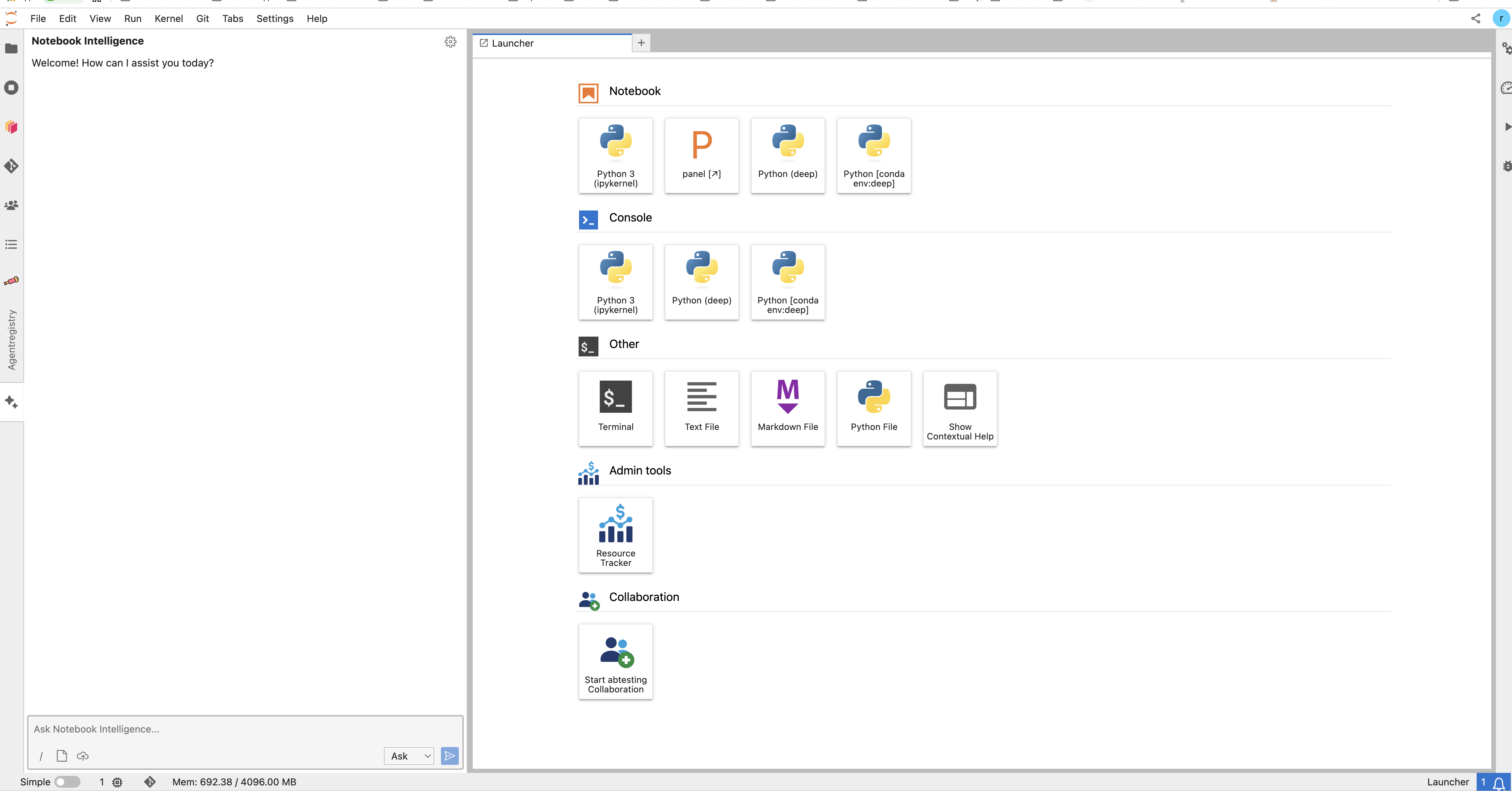
The Notebook Intelligence panel. Type your question at the bottom.
...
Example — public data. Pick a public AWS dataset, find the granule you need, and pull it straight in.
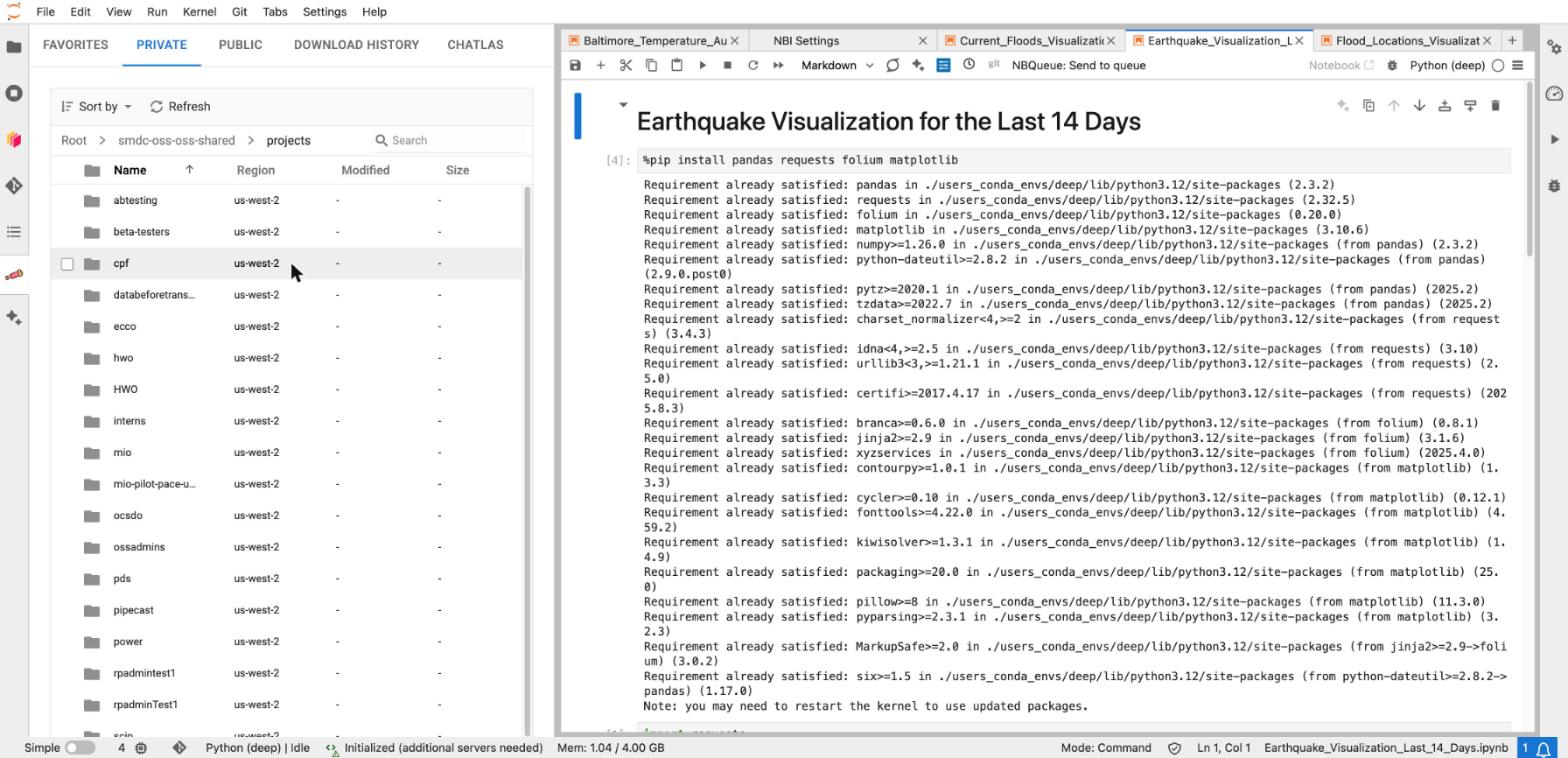
The PRIVATE tab: the platform bucket, opened to the shared projects folder.
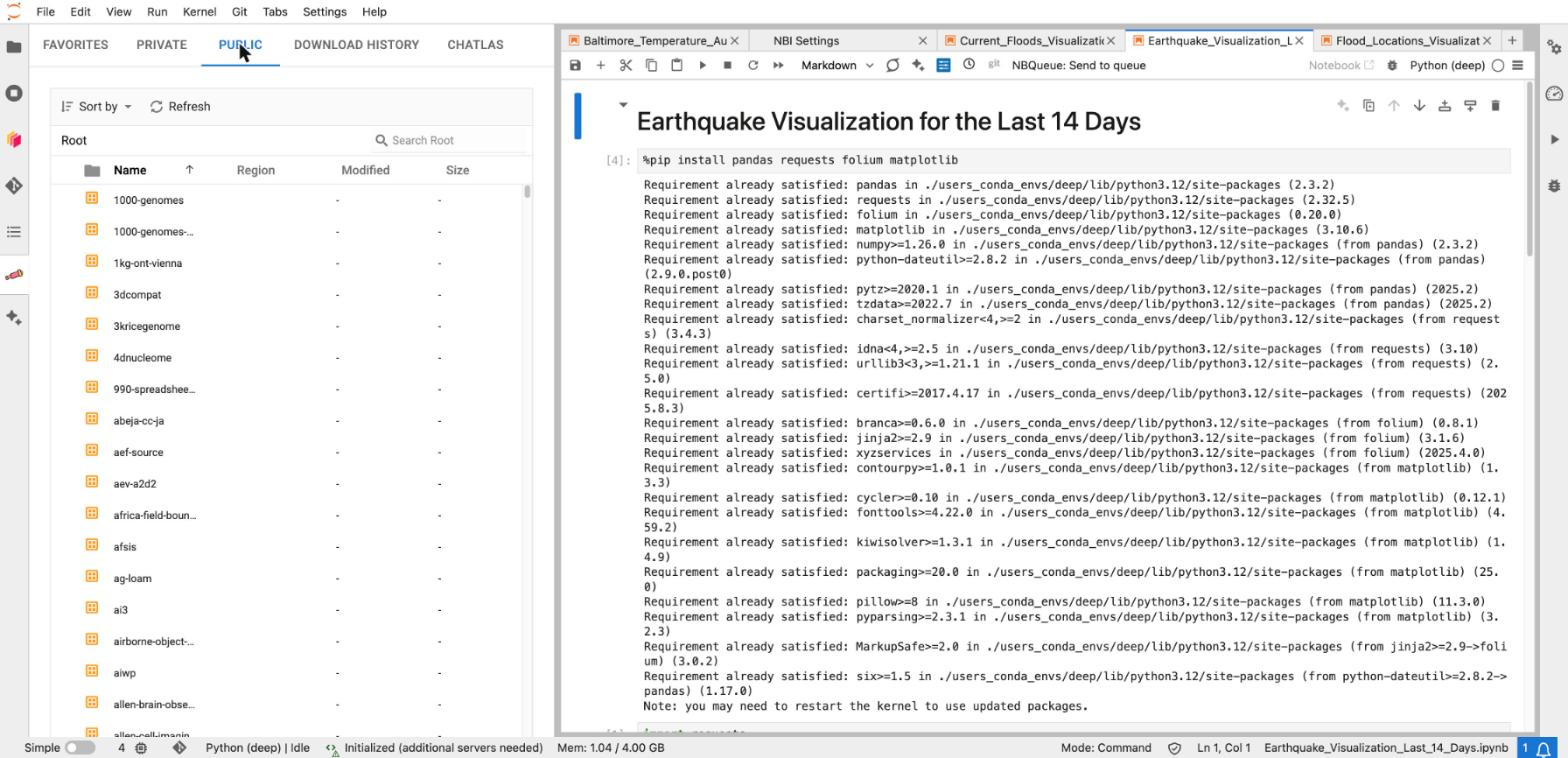
The PUBLIC tab: public AWS science datasets.
...
How you use it. Open the notebook and press NBQueue: Send to queue in the toolbar. Choose the machine. Send it. Watch the status in the NBQueue panel. When it finishes, you get the finished notebook, with its output.
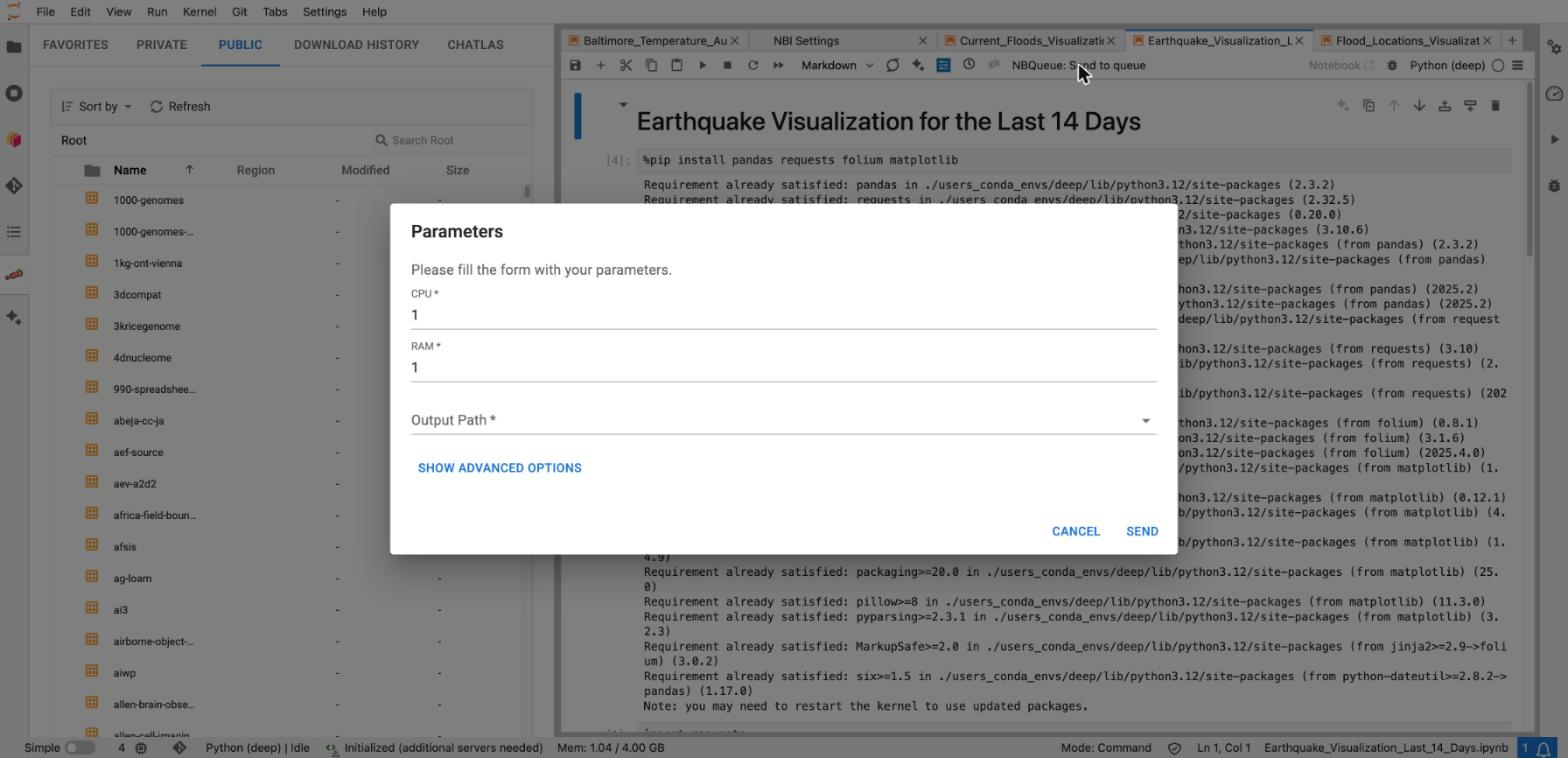
The NBQueue form: CPU, memory, and the output path.
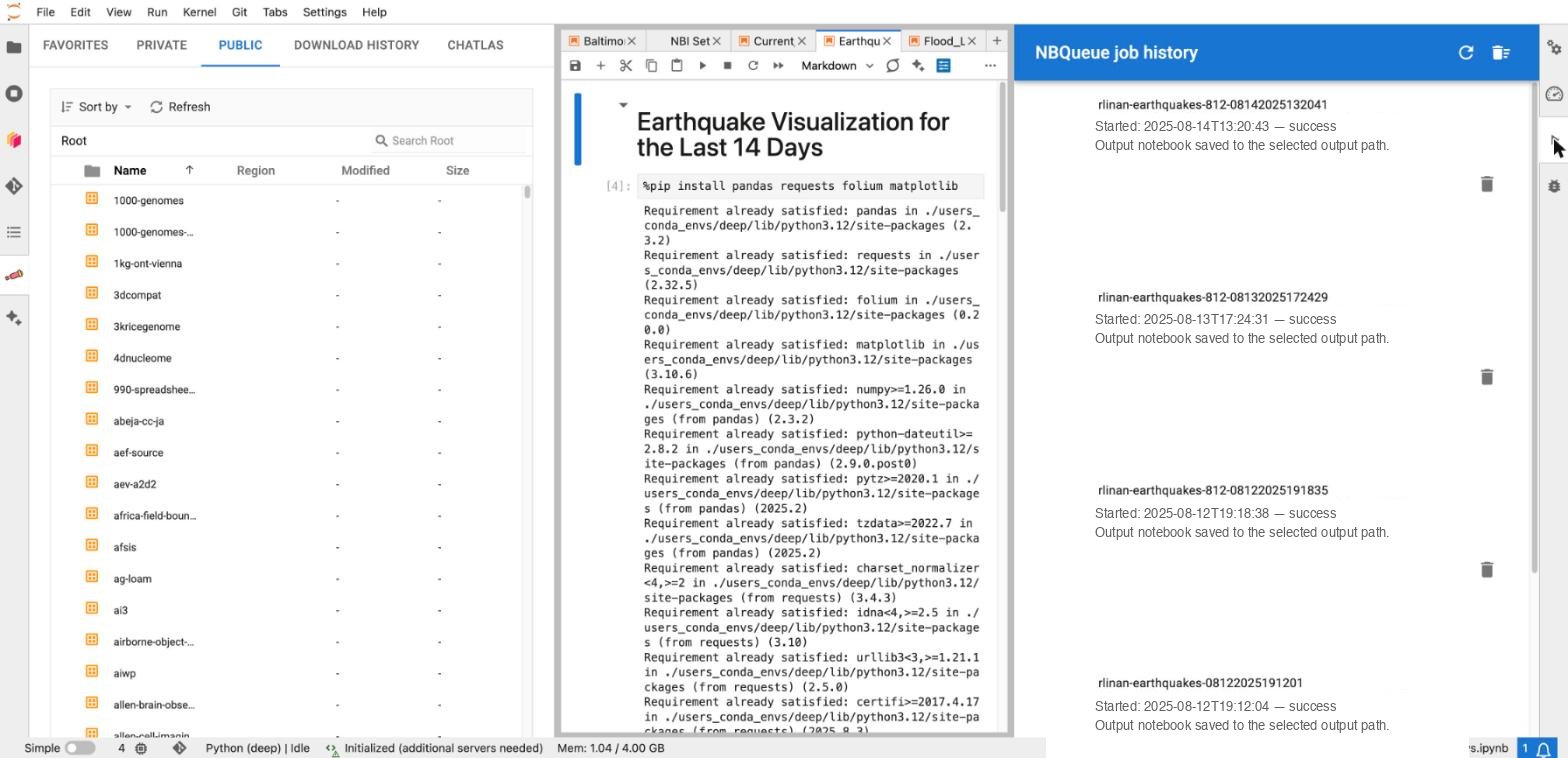
The NBQueue job history panel, in the right sidebar.
...
Stopping it. Click the tile again to stop the shared session. The tile reads Start when the session is down, and Join and Stop while it is up.
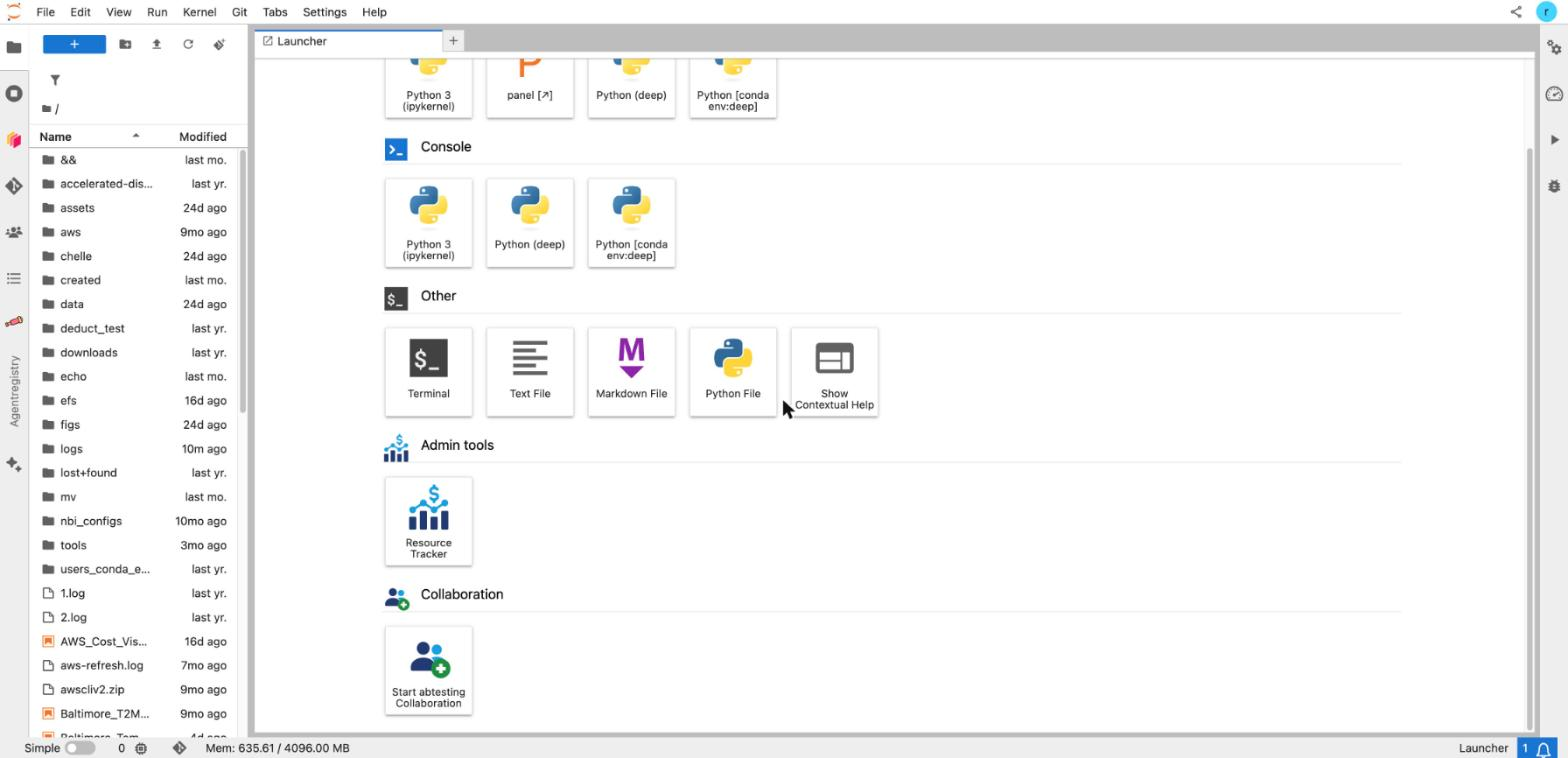
Before the session starts: one tile, "Start abtesting Collaboration".
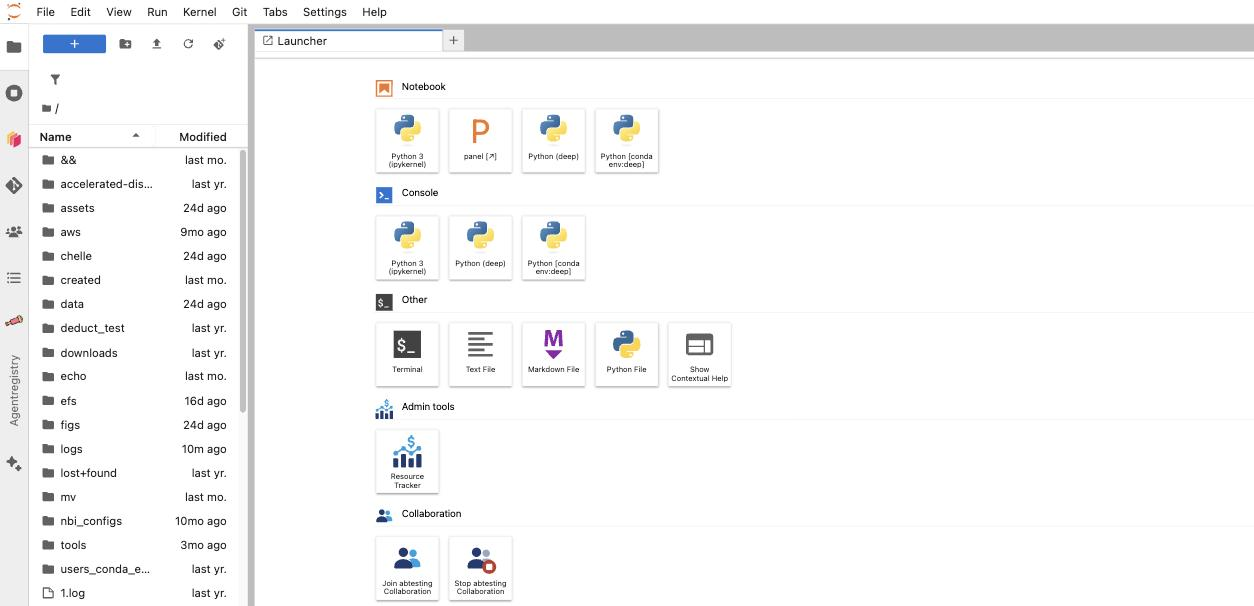
While the session runs: "Join abtesting Collaboration" and "Stop abtesting Collaboration".
...
- This month — hours used, compute cost, and storage cost split into shared filesystem, workspace disk, and object storage.
- Funding period to date — used, allocated, and remaining. (The funding block is hidden if you have no allocation.)
- Last updated — when the numbers were prepared.
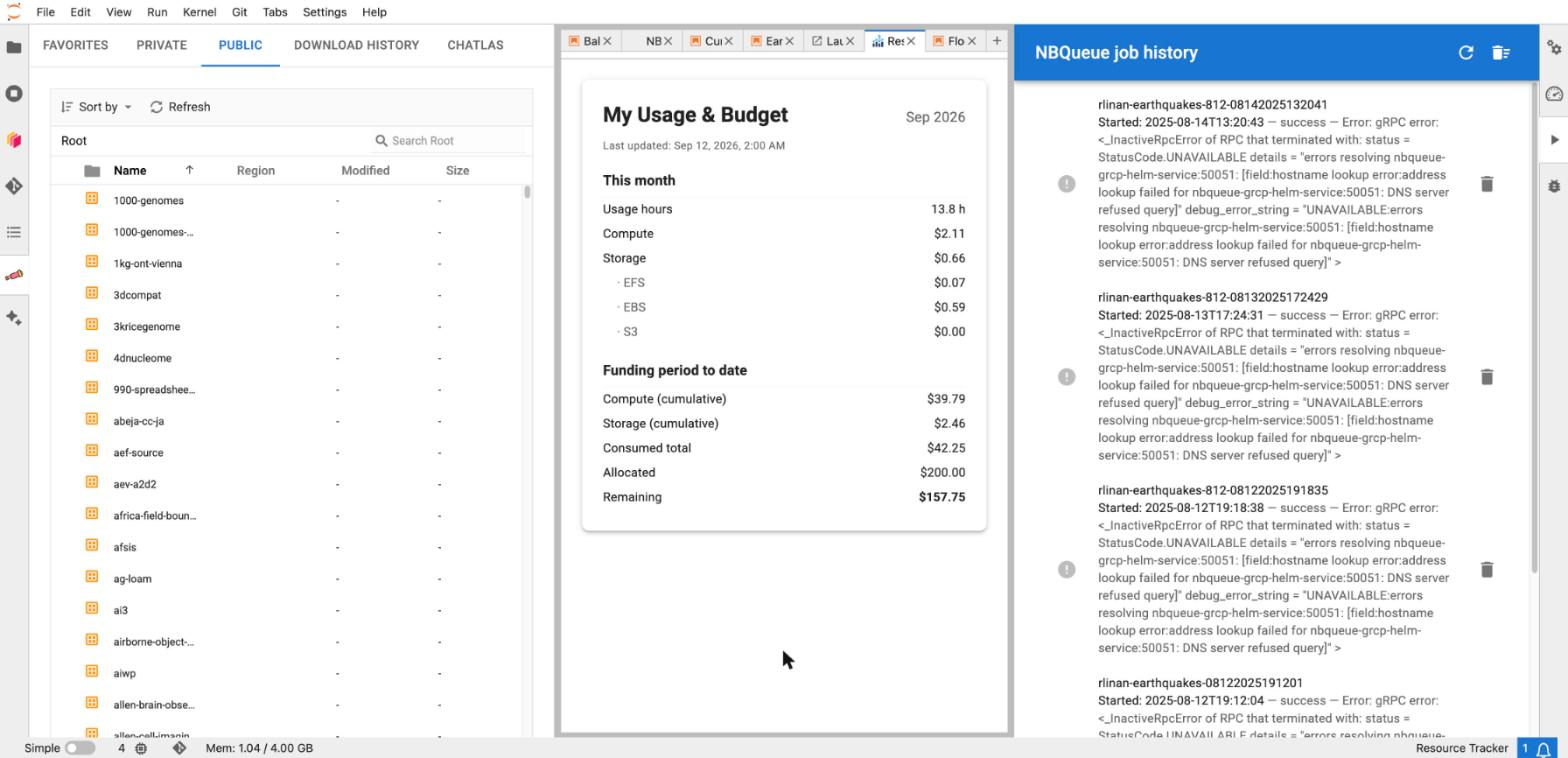
The Resource Tracker panel: This month, and Funding period to date.
...
Watch out. The numbers are read when your workspace starts, and the cost data is prepared once a day. The panel does not tick up while you work. To get fresher numbers, stop your workspace and start it again.
10.
...
SI Registry — shared, NASA-validated
...
SI building blocks
What it is. A hub of AI SI building blocks that NASA colleagues have shared and NASA has validated. Instead of every team building the same AI SI plumbing, you take a piece that already works and has passed review.
What it holds.
| Block | In plain words |
|---|---|
| MCP servers | A small service that gives an |
| SI assistant a new skill — for example, search a data catalog, or query a database | |
| Skills | A packaged way of doing one job well |
| Agents | An |
| SI worker that carries out a task with several steps | |
| Models | A trained model you can call |
| Prompts | A tested instruction that gets a good answer |
| Harnesses | The scaffolding that holds the pieces together |
Where. The AgentRegistry panel in the left sidebar of JupyterLab.
...
The three buttons on each card.
| Button | What it does |
|---|---|
| Add to NBI | Hands the tool to your |
| SI assistant (Notebook Intelligence), so it can use it in your next question | |
| Deploy | Starts the tool for you |
| Undeploy | Stops it again |
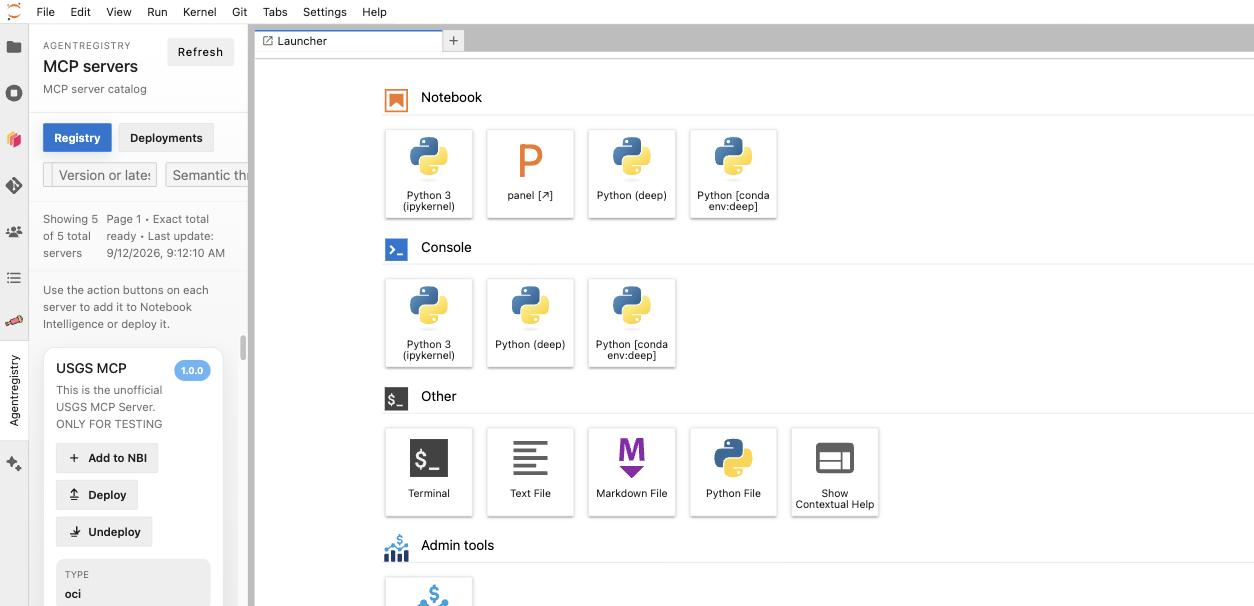
The AgentRegistry panel: the MCP server catalog, with the Add to NBI, Deploy, and Undeploy buttons on a card.
...