
| Info |
|---|
Read time: 6 minutes. Short version: JupyterLab has a built-in AI SI assistant. You choose which AI SI model it talks to. You can bring your own, buy a GitHub Copilot seat through the Science Cloud, or ask to join the pilot for the Science Cloud's own model. |
...
Notebook Intelligence is the AI SI assistant built into your workspace. It is not a separate web page. It sits next to your notebook.
An LLM (large language model) is the AI SI model that answers. Notebook Intelligence is the part in JupyterLab; the LLM is the brain it talks to. You choose the brain.
What it can do
| Feature | What it means for you |
|---|---|
| Chat | Ask a question in a side panel and get an answer about your code or your data |
| Inline completion | It suggests the rest of the line or block as you type |
| Agent mode | It can create a notebook, edit cells, and run them for you |
| Tools (MCP) | It can use extra tools you give it, such as a data-catalog search |
| Approval step | For actions that change things, it asks you first |
| Multimedia | ||||
|---|---|---|---|---|
|
Notebook Intelligence at work, recorded in a live workspace.
Examples
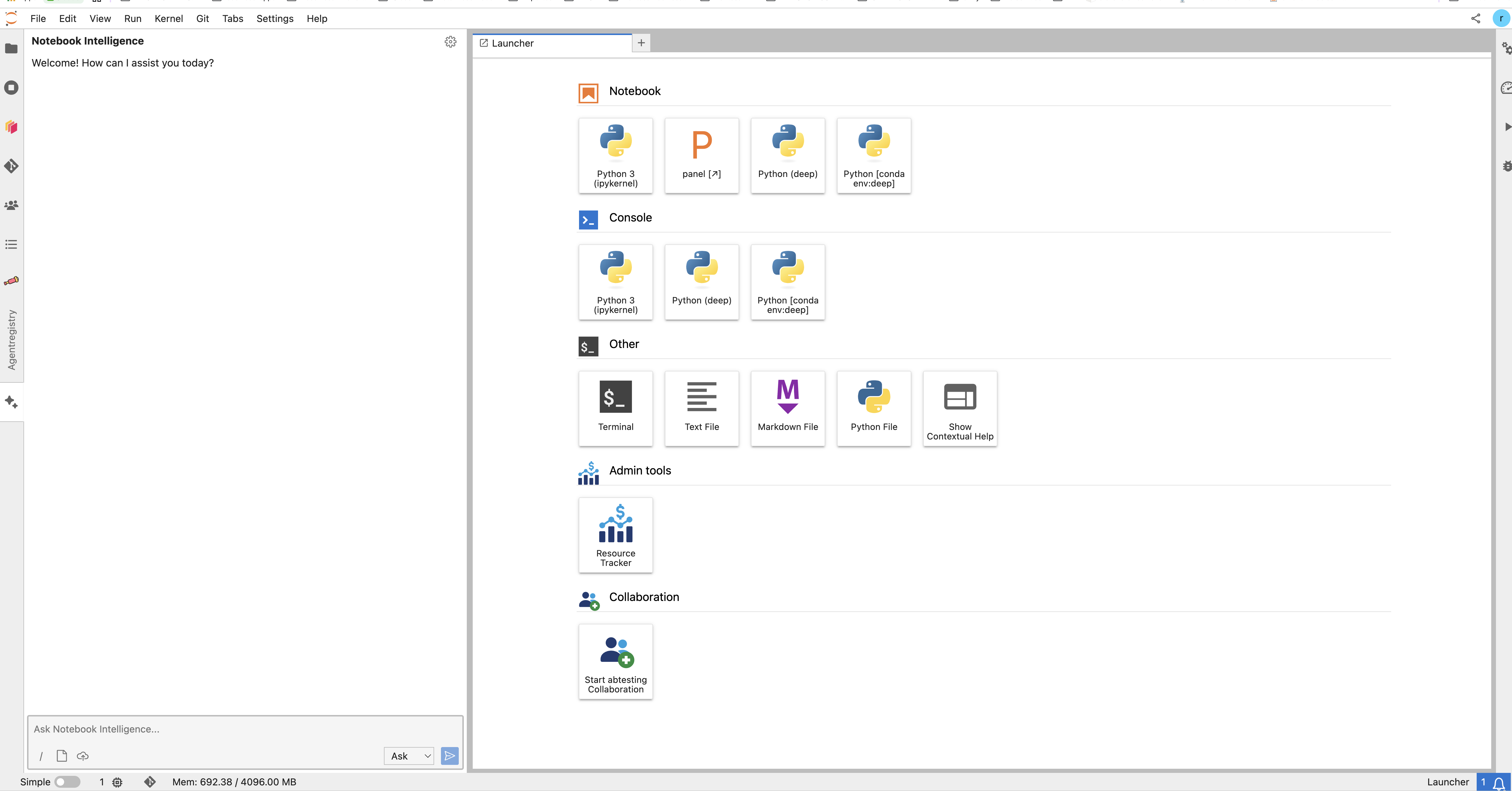
The chat panel. The mode selector next to the send button chooses between asking and acting.
...
Your three ways to get a model
| Way | What you do | Who pays |
|---|---|---|
| 1. Bring your own | Use your own licence or API key from a provider | You or your project, direct to the provider |
| 2. GitHub Copilot through the Science Cloud | Ask the Science Cloud for a Copilot subscription | Through the Science Cloud |
| 3. Skippy — the Science Cloud's own model | Ask to become a pilot user | The Science Cloud |
| Warning |
|---|
Skippy is in pilot. The Science Cloud's internal model, Skippy, is not a general service yet. It is running as a pilot. Ask |
Coming later. Running models through the AI SI Registry, and through AWS Bedrock. Not available today.
...
Notebook Intelligence supports these provider types:
| Provider | Notes |
|---|---|
| GitHub Copilot | Sign in with your GitHub account |
| OpenAI-compatible | Any service that speaks the OpenAI API — this is the setting to use for most hosted models, and for the Science Cloud's own endpoint |
| LiteLLM-compatible | For a LiteLLM gateway |
| Ollama | Models running locally, in your own workspace |
| Anthropic Claude | Through the Claude Code command-line tool, in Claude mode |
How to connect a model
- In JupyterLab, open the assistant's chat panel.
- Click the gear icon. (Or use Settings → Notebook Intelligence Settings.)
- Choose the provider type from the list above.
- Fill in what it asks for — usually a model name, an address, and an API key.
- Save. Then ask the assistant a question to check it works.
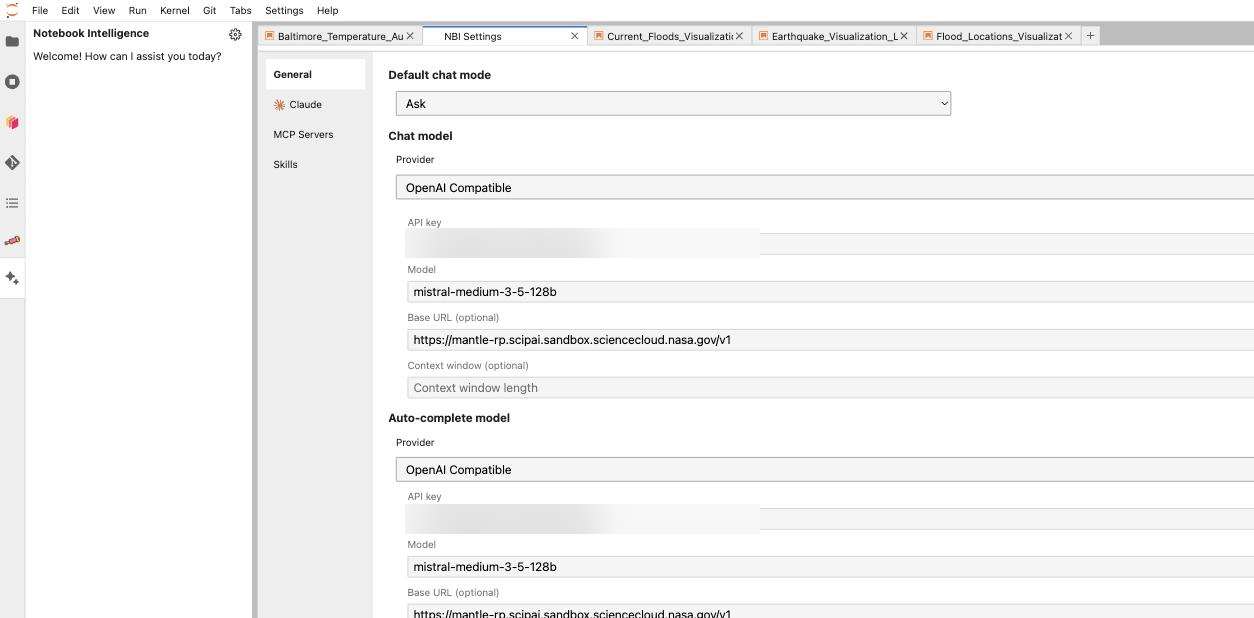
The NBI Settings tab: pick a provider, then enter the model, the address, and the API key. The key fields in this picture are blurred.
...