
| Warning |
|---|
Draft for review. This page is under review before the Operational Readiness Review. Panels marked as open questions are still waiting for an answer. Send corrections to the Research Platform team. |
...
This guide features one section per tool. Each section
...
explains what
...
the tool is, where to find it, provides an example, and highlights what to watch out for. Prefer a step-by-step walkthrough
...
?
...
Read your first day instead
...
.
...
Tools at a
...
Glance
| Tool |
|---|
| Common Question | Availability |
|---|---|
| JupyterLab and |
| Notebooks | Where do I work? | Everyone |
| Machine |
| Sizes and |
| Images | How much compute power do I get? | Everyone |
| Storage | Where do my files go, and what survives a restart? | Everyone |
| Your |
| Own Kernel | How do I |
| install my own packages? | Everyone | |
| Notebook Intelligence | Can AI help me code? | Everyone |
| Data |
| Browser | How do I |
| access cloud data? | Everyone |
| Dask | How do I |
| speed up processing? | Everyone |
| NBQueue | How do I |
| execute long-running tasks? | Everyone | |
| RTC Launcher | How do we edit together? | Projects with collaboration |
| enabled | ||
| Resource Tracker | What am I spending? | Everyone |
| AI Registry | What shared AI |
| components can I reuse? | Rolling out | |
| Git | How do I manage code versions? | Everyone |
1. JupyterLab and
...
Notebooks
What it is
...
: Your browser-based workspace. A notebook
...
consists of a
...
series of cells: you write code in a cell,
...
execute it, and the result appears
...
directly beneath it.
Where
...
to find it:rp.sciencecloud.nasa.gov
...
(after
...
logging in).
Example
...
: Open the Launcher, click on a Python notebook, type print("hello"), and press Shift+Enter.
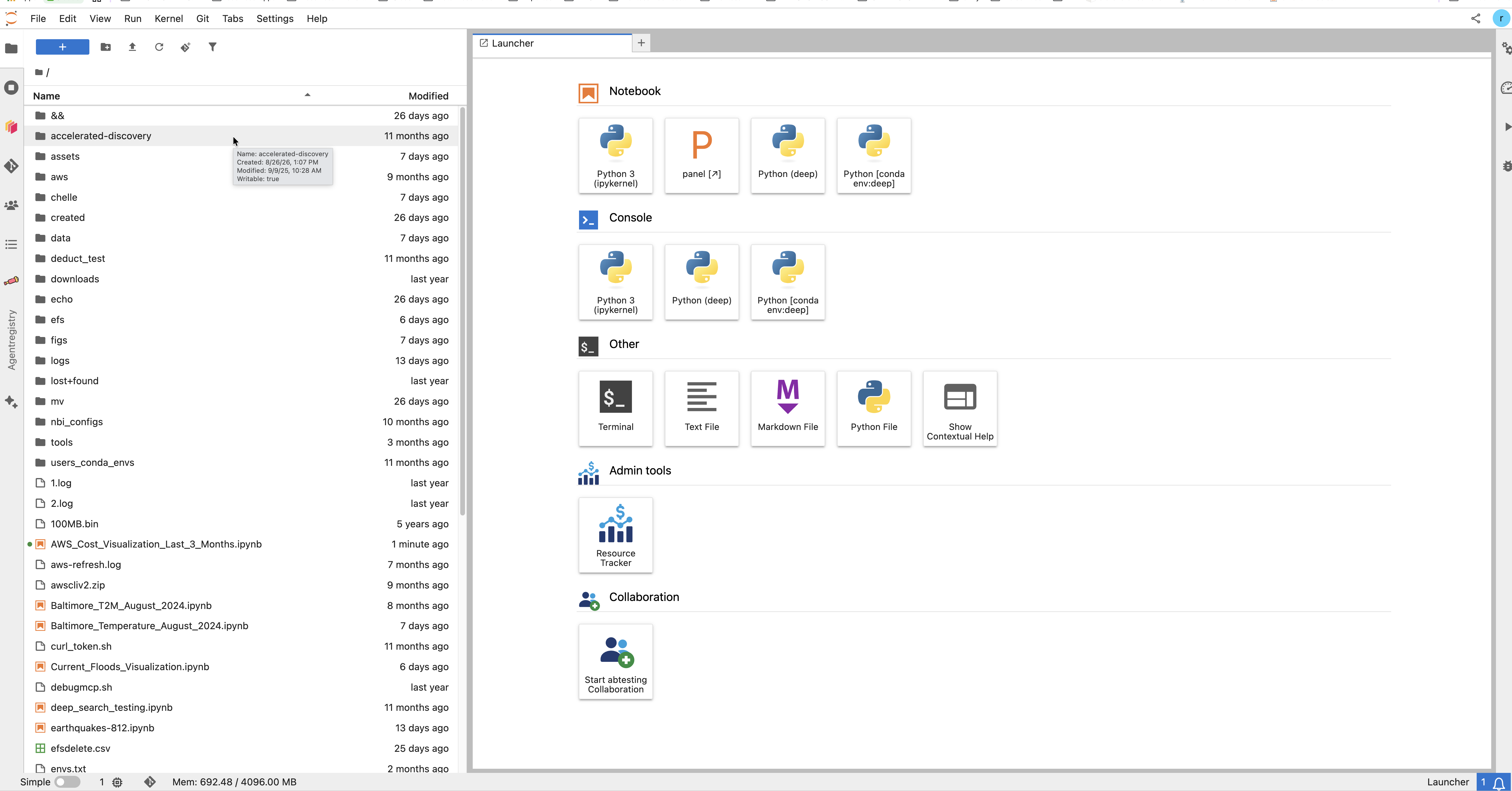
JupyterLab: file browser, Launcher tiles, and the platform tools down the left edge.
...
Important Reminder: Your workspace incurs costs
...
while it runs.
...
Please stop your session when you
...
are finished.
2. Machine
...
Sizes and Software Images
When launching a session, you configure your workspace by selecting your compute size, software environment, and associated project.
Choosing a Server Type
Your server type dictates your compute power. Because larger machines cost more per hour, you should select the size that best fits your immediate task to optimize your budget. For example, a Standard instance is perfect for reading a single file and creating a simple plot, whereas holding a large dataset in memory requires the r5.2xlarge node.
| Server Type | Resources Included |
|---|---|
| Standard | Up |
What it is. At launch you choose the size of your machine and the software set.
Sizes. The Server Type list on the launch screen:
| to 4 GB RAM / 4 CPU |
| Large |
| Up to 8 GB RAM / 4 CPU |
| Extra Large |
| Up to 16 GB RAM / 4 CPU |
| r5.2xlarge Node (On Demand) |
| Up to 64 GB RAM / 8 CPU |
...
Roadmap Note: GPU-enabled machines and the ability for project admins to curate custom server lists for their teams will be available in future updates.
Selecting Your Software and Project
The Images list
...
provides ready-made software stacks,
...
such as the Earth Science Server (with AI Intelligence).
...
If your team has a custom-built software image, you can load it using the "Other" field.
Finally, use the Project dropdown to select your active project. This ensures your session is billed to the correct budget and gives you access to the appropriate project storage.
Project. The Project list decides which project storage the session can reach, and which budget it is charged to.
Example. Reading one file and plotting it? Take Standard. Holding a large dataset in memory? Take r5.2xlarge.
| Info |
|---|
Coming later. Two changes to this list are on the roadmap: GPU machines, and letting a project admin build and maintain their own list of server types for their team, instead of everyone choosing from one platform-wide list. |
Watch out. A bigger machine costs more per hour. Take the size the job needs, not the biggest one on the list.
3. Storage — home, EFS, and object storage
What it is.:
Storage locations for your Places to keep files, each with different distinct sharing rules — and different behaviour behaviors when your workspace restarts.
| Place | Path | Who sees it | Survives a restart? |
|---|---|---|---|
| Home folder | ~ = /home/<your name>, for example /home/ramon.linan | Only you | ✅ Yes |
| Your own EFS folder | /efs/<your username>, in email form — for example /efs/ramon.linan@navteca.com | Only you | ✅ Yes |
| Project folder on EFS | /efs/<project>, one for every project you belong to | Everyone in that project | ✅ Yes |
| Object storage — yours | s3://<bucket>/home/<your username> | Only you | ✅ Yes |
| Object storage — project | s3://<bucket>/<project> — the project you chose at launch | Your project | ✅ Yes |
| Everything else | /tmp, system folders, packages installed outside your home folder | — | ❌ No. Lost. |
Example. You : If you download a 200 GB dataset for the your team. Put , place it in the project's object storage , not in rather than your personal home folder. Keep your own individual notebooks in your home folder. Put a , and place shared intermediate result results in /efs/<project>.
Good to know
...
:
- The
/efs/directory lists a folder for every project you belong to. Permissions stop - automatically prevent you from opening other people
- users' or projects' s
- folders.
- The JupyterLab file browser and the terminal show
- display the exact same files, just in a
- different layout
- layouts. The permissions are the same
- identical in both.
- Object storage in a remote AWS account (such as your institution's ,
- or a specific mission's) is not charged to your Science Cloud project. (See "How you pay for it" for more details).
...
Home Folder Size:
Your home folder
...
starts at 10 GB
...
. It can be expanded by submitting a request to the platform team, but avoid requesting more space than necessary—a very large home volume
...
can slow down your workspace
...
startup time. Instead, store large datasets in /efs/<project> or in object storage
...
.
...
Cost Consideration: You incur monthly charges for the storage allocated in EFS,
...
your home volume, and
...
object storage—whether that space is actively used or not.
...
To optimize costs, regularly delete files you no longer need.
3b. Your own kernel from a conda environment
...
Where. Inside JupyterLab, next to your notebook.
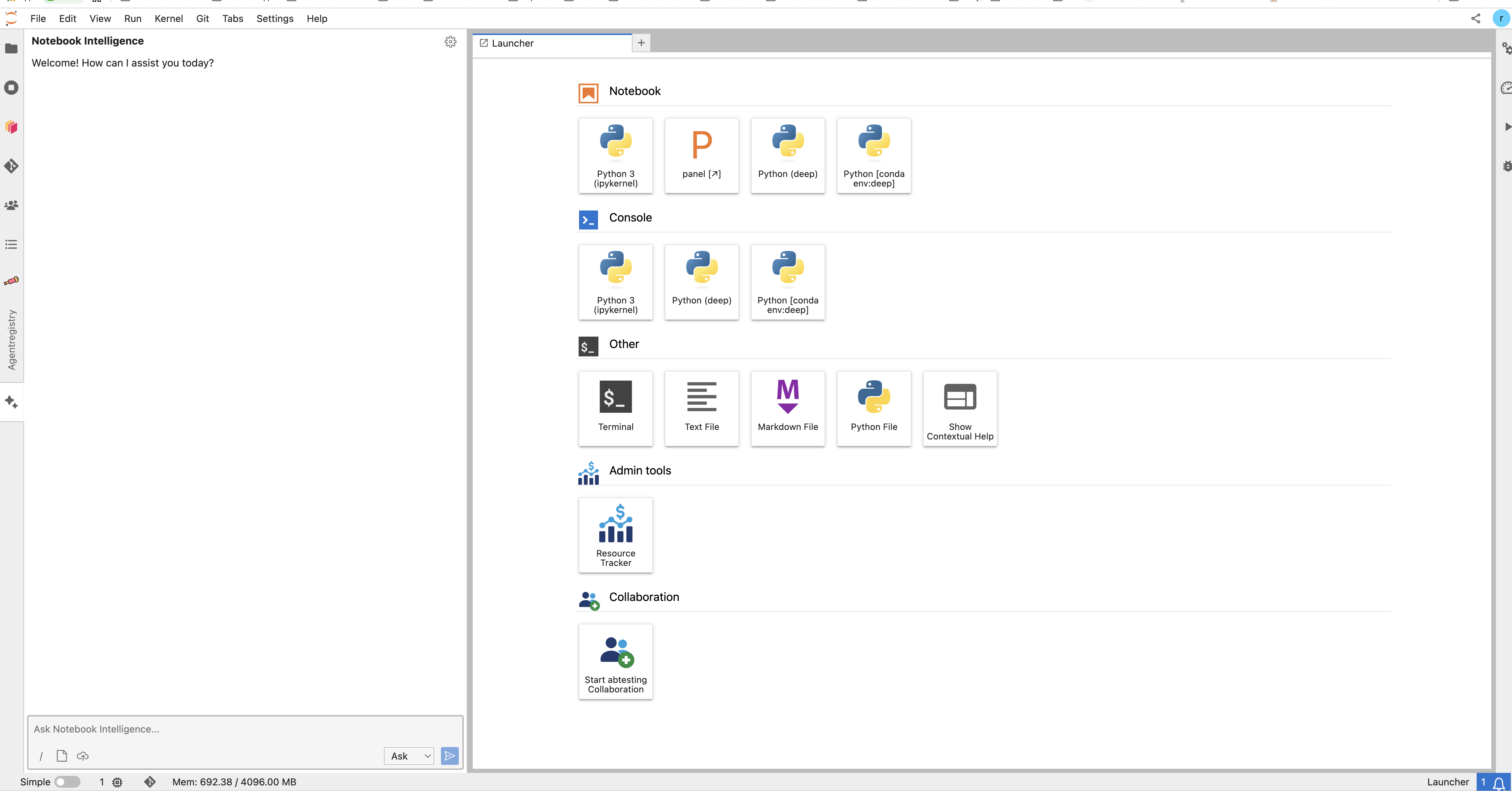
The Notebook Intelligence panel. Type your question at the bottom.
...
What it is. A hub of AI building blocks that NASA colleagues have shared and NASA has validated. Instead of every team building the same AI plumbing, you take a piece that already works and has passed review.
What it holds.
| Block | In plain words |
|---|---|
| MCP servers | A small service that gives an AI assistant a new skill — for example, search a data catalog, or query a database |
| Skills | A packaged way of doing one job well |
| Agents | An AI worker that carries out a task with several steps |
| Models | A trained model you can call |
| Prompts | A tested instruction that gets a good answer |
| Harnesses | The scaffolding that holds the pieces together |
Where. The AgentRegistry panel in the left sidebar of JupyterLab.
...
The three buttons on each card.
| Button | What it does |
|---|---|
| Add to NBI | Hands the tool to your AI assistant (Notebook Intelligence), so it can use it in your next question |
| Deploy | Starts the tool for you |
| Undeploy | Stops it again |
Example. You want your assistant to answer questions from a USGS data service. Open AgentRegistry → Registry, find the USGS MCP server, press Deploy, then press Add to NBI. Now ask your assistant a question about that data, and it uses the tool.
...